Apps and web tools.
The product catalog. Each entry below is designed, built, and operated by Mr. Jackdaw Company.
Native iOS apps.
On-device processing. No subscriptions.
HopStop
“Your day, mapped.”
- Google Calendar and Apple Calendar integration
- Drive time computation across all stops
- Stop reordering
- One-tap navigation handoff
- On-device processing
A workday of appointments (each with an address) usually means manually looking up routes, reordering stops by hand, and re-entering addresses into navigation apps. The calendar already has the data; every other tool ignores it.
HopStop connects to Google Calendar and Apple Calendar, reads appointments that have addresses, and builds a route. Drive times are computed across all stops; appointments display as a map, not a list. One tap hands off to a preferred navigation app.
On-device. Freemium with a one-time Pro IAP.
Pounce
Strategic board game.
- 5×5 and 7×7 boards
- Three AI difficulty levels
- Pass-and-play multiplayer
- Blocked tile and jump limit variants
- One-time purchase, no IAP
Pounce extends the classic placement format. Players take turns placing tiles on a grid; the goal is to form a line.
A player can leap over an adjacent opponent tile, converting it and landing on the far side: a two-tile swing per move. The board turns over faster than it looks.
Pattern recognition alone does not win, because early positions stay reversible. Positional play matters; so does tempo.
Web research tools.
Applications that turn inconsistent source data into a single schema and a comparison interface.
Choose My Plane
Aircraft comparison and cost modeling.
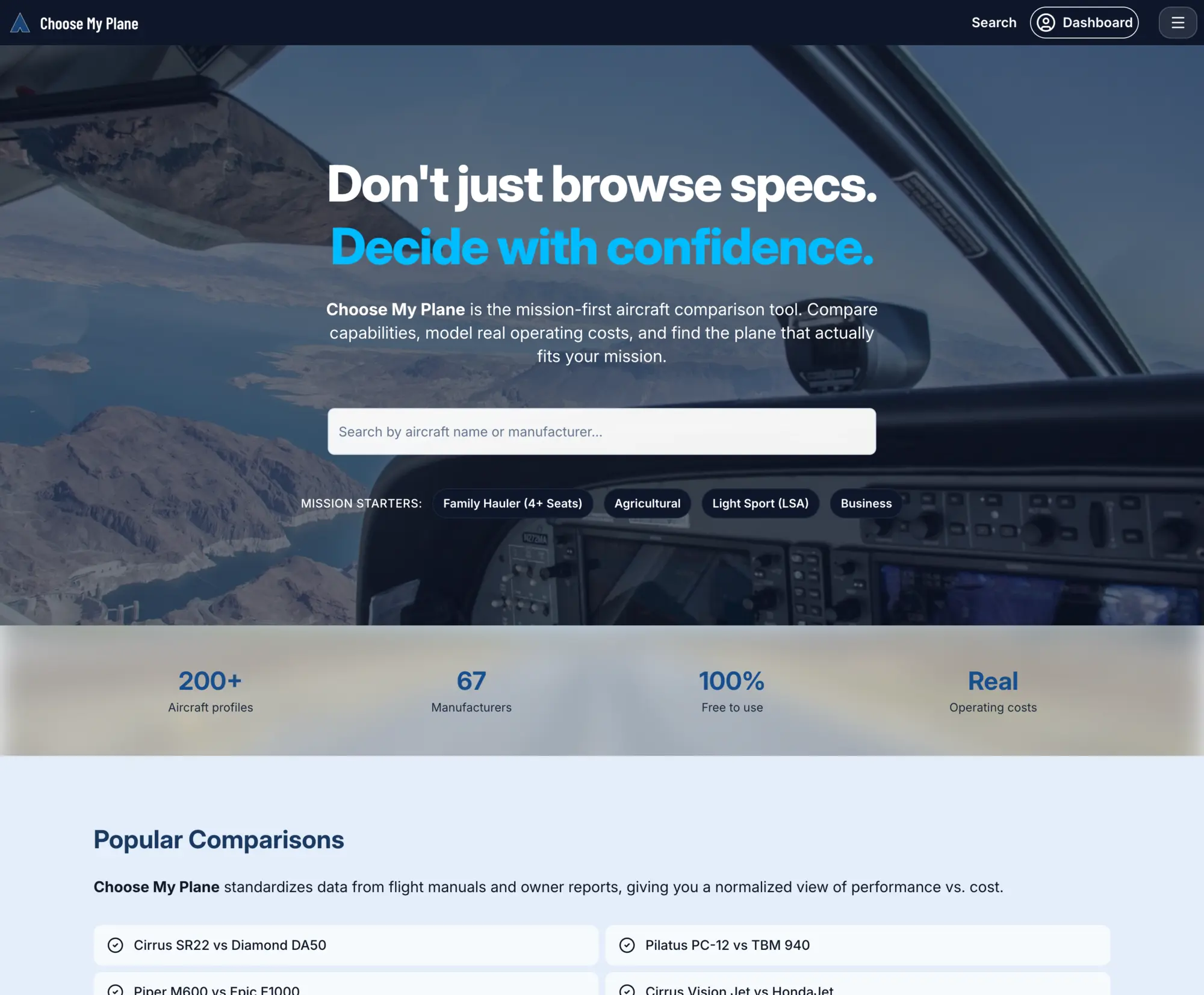
An aircraft purchase is a major financial decision for a private buyer. The research is a scattered mix of PDFs, forum posts, and broker opinions. Performance data is hard to compare because manufacturers report it differently, and operating costs are hard to model without building a spreadsheet.
Choose My Plane brings data from flight manuals and owner reports into a consistent schema, then lets a buyer filter by mission type, compare up to five aircraft side by side, and model total cost of ownership.
The data layer reconciles inconsistent reporting standards across 200+ aircraft from 67 manufacturers: performance figures, fuel burn, range, payload, and cost components. The front-end exposes this through range maps, side-by-side comparison tables, and exportable reports.
Questions are welcome.
Get in touch